




Sale!

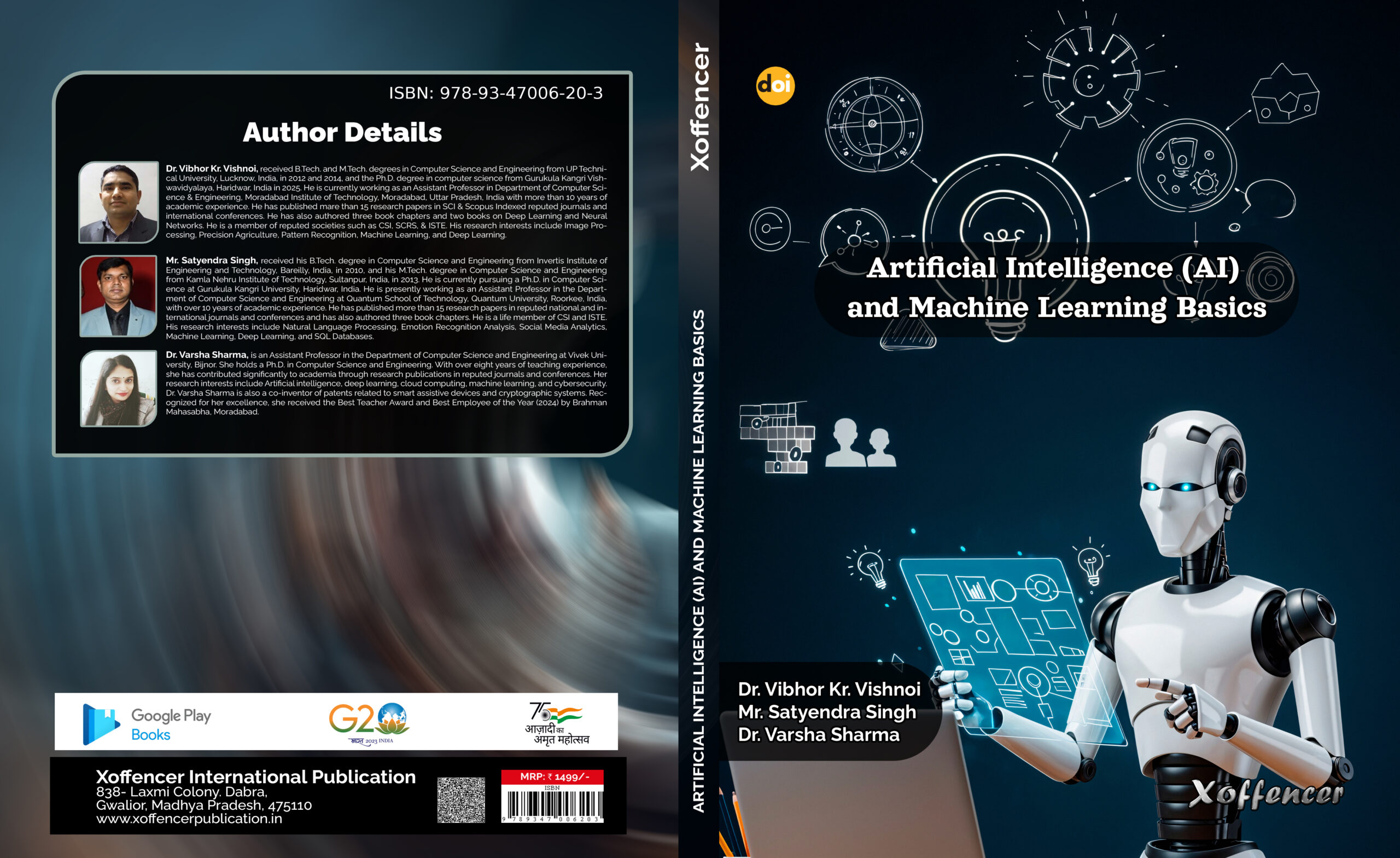
ARTIFICIAL INTELLIGENCE (AI) AND MACHINE LEARNING BASICS

Dr. Vibhor Kr. Vishnoi

Assistant Professor

Department of Computer Science & Engineering

Moradabad Institute of Technology, Moradabad, Uttar Pradesh, India.

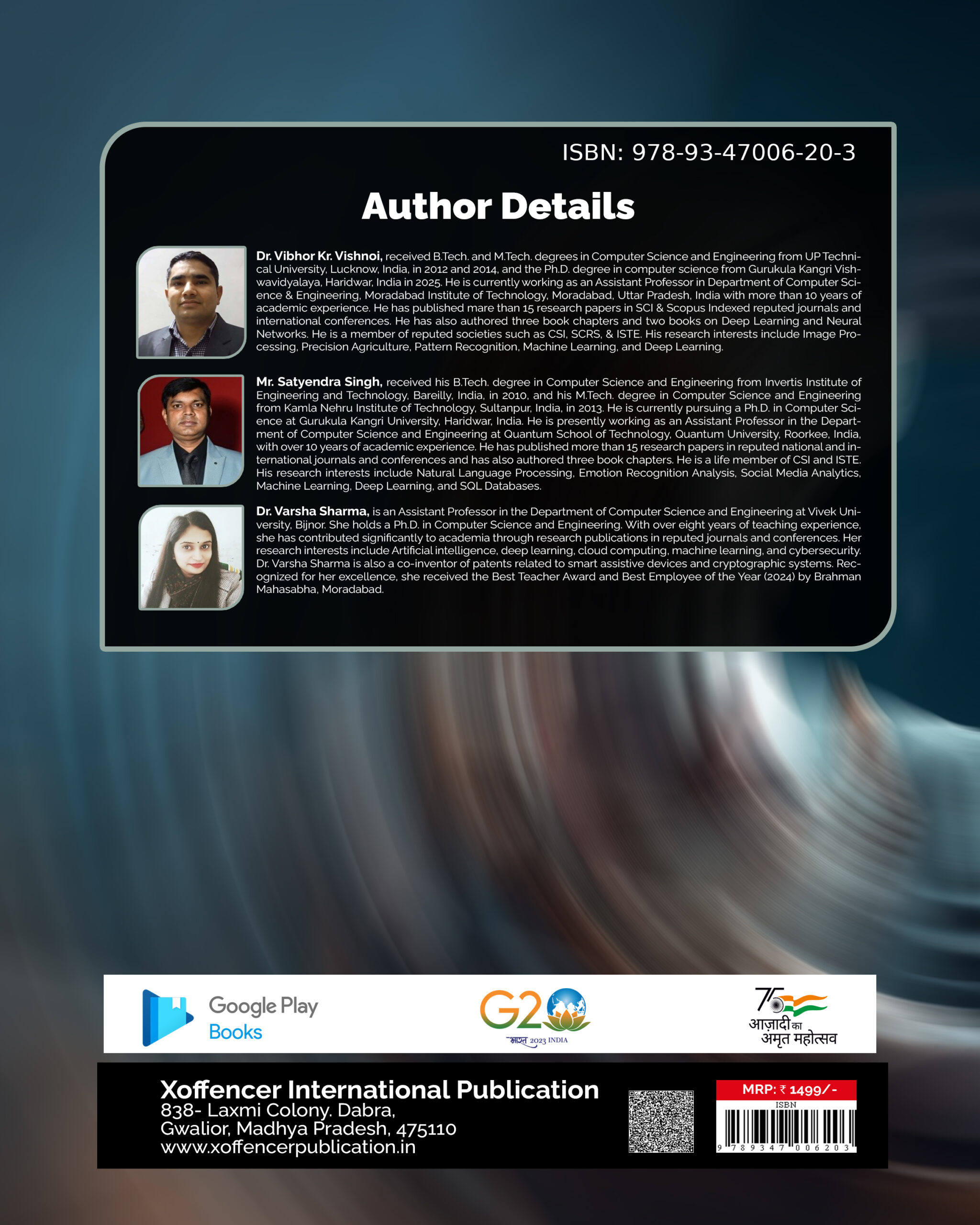
Dr. Vibhor Kr. Vishnoi received B.Tech. and M.Tech. degrees in Computer Science and Engineering from UP Technical University, Lucknow, India, in 2012 and 2014, and the Ph.D. degree in computer science from Gurukula Kangri Vishwavidyalaya, Haridwar, India in 2025. He is currently working as an Assistant Professor in Department of Computer Science & Engineering, Moradabad Institute of Technology, Moradabad, Uttar Pradesh, India with more than 10 years of academic experience. He has published mare than 15 research papers in SCI & Scopus Indexed reputed journals and international conferences. He has also authored three book chapters and two books on Deep Learning and Neural Networks. He is a member of reputed societies such as CSI, SCRS, & ISTE. His research interests include Image Processing, Precision Agriculture, Pattern Recognition, Machine Learning, and Deep Learning.

Mr. Satyendra Singh

Assistant Professor

Department of Computer Science and Engineering at Quantum School of Technology

Quantum University, Roorkee, India,

Mr. Satyendra Singh received his B.Tech. degree in Computer Science and Engineering from Invertis Institute of Engineering and Technology, Bareilly, India, in 2010, and his M.Tech. degree in Computer Science and Engineering from Kamla Nehru Institute of Technology, Sultanpur, India, in 2013. He is currently pursuing a Ph.D. in Computer Science at Gurukula Kangri University, Haridwar, India. He is presently working as an Assistant Professor in the Department of Computer Science and Engineering at Quantum School of Technology, Quantum University, Roorkee, India, with over 10 years of academic experience. He has published more than 15 research papers in reputed national and international journals and conferences and has also authored three book chapters. He is a life member of CSI and ISTE. His research interests include Natural Language Processing, Emotion Recognition Analysis, Social Media Analytics, Machine Learning, Deep Learning, and SQL Databases.

Dr. Varsha Sharma

Assistant Professor

Department of Computer Science and Engineering at Vivek University, Bijnor

Dr. Varsha Sharma is an Assistant Professor in the Department of Computer Science and Engineering at Vivek University, Bijnor. She holds a Ph.D. in Computer Science and Engineering. With over eight years of teaching experience, she has contributed significantly to academia through research publications in reputed journals and conferences. Her research interests include Artificial intelligence, deep learning, cloud computing, machine learning, and cybersecurity. Dr. Varsha Sharma is also a co-inventor of patents related to smart assistive devices and cryptographic systems. Recognized for her excellence, she received the Best Teacher Award and Best Employee of the Year (2024) by Brahman Mahasabha, Moradabad.

Description

The emergence of machine learning (ML) and artificial intelligence (AI) has been groundbreaking in a variety of disciplines, and it is transforming the way that individuals utilize technology to address challenges. The fundamental concept underlying artificial intelligence is the ability to make computers think in the same way that people do. This will enable children to be capable of doing tasks such as comprehending language, discerning patterns, and forming opinions. The field of machine learning is a subset of artificial intelligence, and its objective is to develop algorithms that are capable of becoming increasingly more proficient over the course of time without any assistance from a human being or any coding. Possessing a good foundation in artificial intelligence (AI) and machine learning (ML) opens the door to a multitude of potential benefits, including the automation of regular activities, the simplification of complex data analysis, and the acceleration of progress in industries such as healthcare and finance, among others. A few examples are shown below. We will examine the fundamental concepts, applications, and challenges that these potent technologies present by exploring the principles that underlie them. As a result of this, we will get the understanding that is necessary to navigate through the rapidly evolving realm of machine learning and artificial intelligence. As we continue to delve deeper into the realm of artificial intelligence and machine learning, it is essential that we have a solid understanding of the fundamental principles that underpin these technologies. We will begin by investigating some of the most fundamental concepts, including algorithms, data, and the various manifestations of artificial intelligence. We will distinguish between narrow artificial intelligence, which is primarily concerned with accomplishing certain objectives, and wide xix artificial intelligence, which strives to create more general cognitive skills. We will also take a look at the advantages and disadvantages of every one of the many machines learning techniques, including supervised learning, unsupervised learning, and reinforcement learning. During the course of this tour, we will examine how artificial intelligence and machine learning are already integrated into our everyday lives by looking at instances from the actual world. There will be a variety of examples, including applications in the fields of healthcare and finance as well as virtual assistants and recommendation systems. We are going to scrutinize every conceivable ethical concern and hurdle that may arise from their implementation, including issues of data privacy, algorithmic bias, and the necessity for openness in the methods used to make decisions.


Reviews

There are no reviews yet.

Add a review

Your email address will not be published. Required fields are marked *