

Sale!

COMPUTER VISION AND DEEP LEARNING FOR INTELLIGENT AUTOMATION

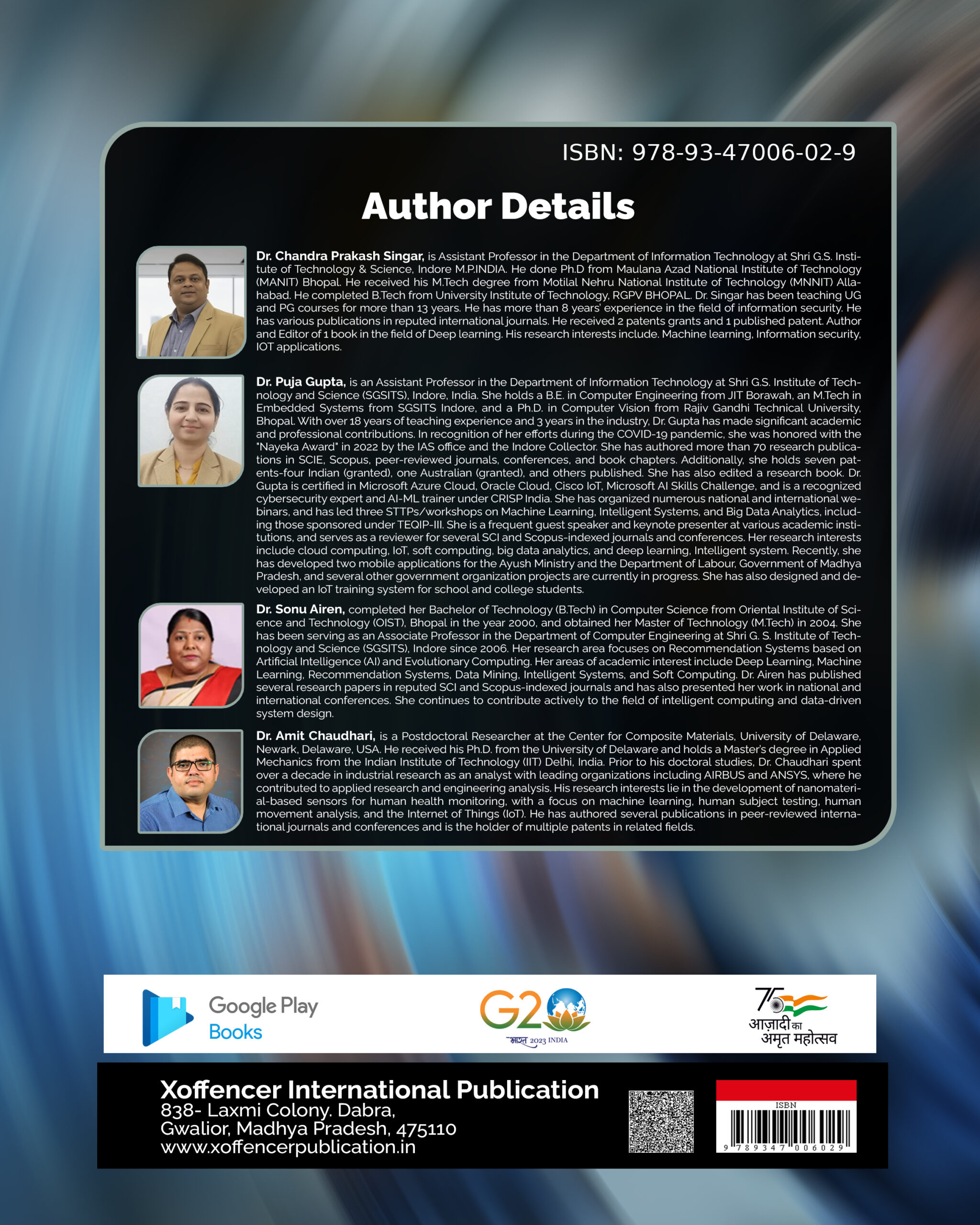
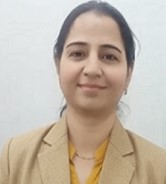
Dr. Chandra Prakash Singar is Assistant Professor in the Department of Information Technology at Shri G.S. Institute of Technology & Science, Indore M.P.INDIA. He done Ph.D from Maulana Azad National Institute of Technology (MANIT) Bhopal. He received his M.Tech degree from Motilal Nehru National Institute of Technology (MNNIT) Allahabad. He completed B.Tech from University Institute of Technology, RGPV BHOPAL. Dr. Singar has been teaching UG and PG courses for more than 13 years. He has more than 8 years’ experience in the field of information security. He has various publications in reputed international journals. He received 2 patents grants and 1 published patent. Author and Editor of 1 book in the field of Deep learning. His research interests include. Machine learning, Information security, IOT applications.

Dr. Puja Gupta is an Assistant Professor in the Department of Information Technology at Shri G.S. Institute of Technology and Science (SGSITS), Indore, India. She holds a B.E. in Computer Engineering from JIT Borawah, an M.Tech in Embedded Systems from SGSITS Indore, and a Ph.D. in Computer Vision from Rajiv Gandhi Technical University, Bhopal. With over 18 years of teaching experience and 3 years in the industry, Dr. Gupta has made significant academic and professional contributions. In recognition of her efforts during the COVID-19 pandemic, she was honored with the “Nayeka Award” in 2022 by the IAS office and the Indore Collector.

She has authored more than 70 research publications in SCIE, Scopus, peer-reviewed journals, conferences, and book chapters. Additionally, she holds seven patents-four Indian (granted), one Australian (granted), and others published. She has also edited a research book.

Dr. Gupta is certified in Microsoft Azure Cloud, Oracle Cloud, Cisco IoT, Microsoft AI Skills Challenge, and is a recognized cybersecurity expert and AI-ML trainer under CRISP India. She has organized numerous national and international webinars, and has led three STTPs/workshops on Machine Learning, Intelligent Systems, and Big Data Analytics, including those sponsored under TEQIP-III. She is a frequent guest speaker and keynote presenter at various academic institutions, and serves as a reviewer for several SCI and Scopus-indexed journals and conferences. Her research interests include cloud computing, IoT, soft computing, big data analytics, and deep learning, Intelligent system. Recently, she has developed two mobile applications for the Ayush Ministry and the Department of Labour, Government of Madhya Pradesh, and several other government organization projects are currently in progress. She has also designed and developed an IoT training system for school and college students.

Dr. Sonu Airen completed her Bachelor of Technology (B.Tech) in Computer Science from Oriental Institute of Science and Technology (OIST), Bhopal in the year 2000, and obtained her Master of Technology (M.Tech) in 2004. She has been serving as an Associate Professor in the Department of Computer Engineering at Shri G. S. Institute of Technology and Science (SGSITS), Indore since 2006.

Her research area focuses on Recommendation Systems based on Artificial Intelligence (AI) and Evolutionary Computing. Her areas of academic interest include Deep Learning, Machine Learning, Recommendation Systems, Data Mining, Intelligent Systems, and Soft Computing.

Dr. Airen has published several research papers in reputed SCI and Scopus-indexed journals and has also presented her work in national and international conferences. She continues to contribute actively to the field of intelligent computing and data-driven system design.

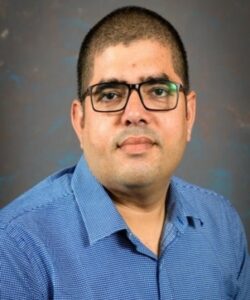
Dr. Amit Chaudhari is a Postdoctoral Researcher at the Center for Composite Materials, University of Delaware, Newark, Delaware, USA. He received his Ph.D. from the University of Delaware and holds a Master’s degree in Applied Mechanics from the Indian Institute of Technology (IIT) Delhi, India.

Prior to his doctoral studies, Dr. Chaudhari spent over a decade in industrial research as an analyst with leading organizations including AIRBUS and ANSYS, where he contributed to applied research and engineering analysis.

His research interests lie in the development of nanomaterial-based sensors for human health monitoring, with a focus on machine learning, human subject testing, human movement analysis, and the Internet of Things (IoT). He has authored several publications in peer-reviewed international journals and conferences and is the holder of multiple patents in related fields.

Description

Supervised learning is a fundamental part of machine learning, and it centers on the creation of prediction models that are based on labeled datasets, in which the learning process is guided by input-output pairs. In this method, algorithms are taught to map inputs to desired outputs by minimizing the discrepancy that exists between the results that were anticipated and those that were actually realized. The two fundamental tasks that are involved in supervised learning are regression, which is used to predict continuous values, and classification, which assigns categorical labels to data. The majority of the applications of supervised learning are built on algorithms like logistic regression, decision trees, linear regression, neural networks, support vector machines, and k-nearest neighbors. These models are put to considerable use in domains including as banking, healthcare, natural language processing, and computer vision, all of which are areas in which making accurate predictions and decisions is of the highest significance. Despite its effectiveness, supervised learning must contend with a number of issues, including over fitting, under fitting, data imbalance, and the need for big, high-quality labeled datasets. Individuals who are interested in improving their abilities in machine learning and artificial intelligence need to have a fundamental grasp of supervised learning. Because it provides the foundation for the development of more advanced methodologies, it is a significant area of study for both scholars and practitioners.

Reviews

There are no reviews yet.

Add a review

Your email address will not be published. Required fields are marked *